


This guide focuses on how to structure and assemble an investment fund pitch deck so it can be reviewed efficiently in professional contexts. It is written for fund managers who already understand the fundamentals of institutional capital and need to translate that understanding into a clear, usable deck.
What follows is strictly execution: slide structure, sequencing, emphasis, and supporting materials that help a fund deck function as a review-ready document.
Contextual Framing
This page operates at the execution layer. It does not define how capital allocation decisions are made, nor does it establish evaluation criteria.
Fund-level capital evaluation logic is defined upstream. In particular, this guide reflects asset- and fund-level capital evaluation expectations outlined in [Asset & Fund Capital Evaluation], and translates those expectations into practical, buildable pitch deck mechanics.
Any references to institutional review behavior are descriptive only and are included to support execution clarity—not to introduce or reinterpret evaluator logic.
Who This Guide Is For (And Who Should Leave Now)
This guide is for people actively creating a pitch deck to pitch investors, not browsing examples for curiosity.
This investment fund pitch deck guide is for:
- First-time fund managers building their first investor pitch deck
- Spin-out partners forming a new VC fund or venture fund
- Real estate and private equity funds raising $5M–$250M
- Family office–backed investment funds pitching limited partners
These readers typically need:
- A clear fund pitch deck structure
- An LP-ready investor deck
- A capital pitch deck that explains investment strategy, fund terms, and projections
- A presentation designed for LPs, VCs, and institutional investors
This guide is not for:
- Startup founders pitching a product or service
- Early-stage founders looking for a startup pitch deck template
- Anyone searching for a free pitch deck or generic pitch deck examples
- Creators focused on design before investment logic
If you’re preparing a winning investor pitch for a fund — keep going.
If you’re looking to “make your deck look nice” before understanding what investors want to know — this isn’t the pitch deck you need.
What LPs and Institutional Investors Evaluate Before They Evaluate Your Slides
Before any slide is discussed, debated, or circulated, a fund pitch deck is first processed through pre-existing review lenses. These lenses are not created by your presentation—they exist long before it arrives. Your deck’s role is not to introduce new decision logic, but to map cleanly onto review expectations that are already in place.
At this stage, reviewers are not reacting to storytelling or persuasion. They are validating whether the material presented aligns with established evaluation dimensions and whether the information required for downstream review is present, coherent, and usable.
From an execution standpoint, this means your deck must support validation across several recurring areas:
Structural Credibility
Review processes look for signals that the fund is institutionally formed, not opportunistically assembled. This includes consistency of structure, clarity of scope, and evidence that the fund model is intentional rather than improvised.
Execution implication:
Slides should follow a disciplined order, avoid redundancy, and clearly separate strategy, economics, governance, and execution. Structural noise is often interpreted as operational risk.
Risk Framing (Not Risk Elimination)
Institutional review does not assume risk can be removed. It evaluates whether risk is identified, bounded, and governed.
Execution implication:
Risk-related information should be explicit, calm, and integrated—not buried or overly defensive. Decks that only emphasize upside tend to create friction during review, not confidence.
Strategy Repeatability
Reviewers assess whether outcomes appear dependent on exceptional circumstances or whether the strategy can be executed consistently over time.
Execution implication:
Your deck should show how decisions are made, not just what past decisions looked like. Process clarity matters more than isolated wins.
Alignment and Incentive Logic
Evaluation frameworks typically examine whether incentives, economics, and governance structures are internally aligned.
Execution implication:
Compensation, ownership, decision rights, and reporting should be easy to trace across slides without contradiction or ambiguity.
Information Clarity
Before judgment, there is comprehension. Reviewers need to understand the fund quickly enough to evaluate it responsibly.
Execution implication:
Slides should prioritize legibility, hierarchy, and restraint. If core mechanics require explanation outside the deck, the deck is doing too much—or too little.
Why This Matters for Execution
A fund pitch deck is not reviewed as a narrative artifact. It is reviewed as an input into a broader decision process. The goal of execution is not persuasion—it is compatibility with how evaluation already works.
The sections that follow focus on how to structure slides, sequence information, and present supporting evidence so the deck can be reviewed, compared, and stress-tested without introducing avoidable uncertainty.
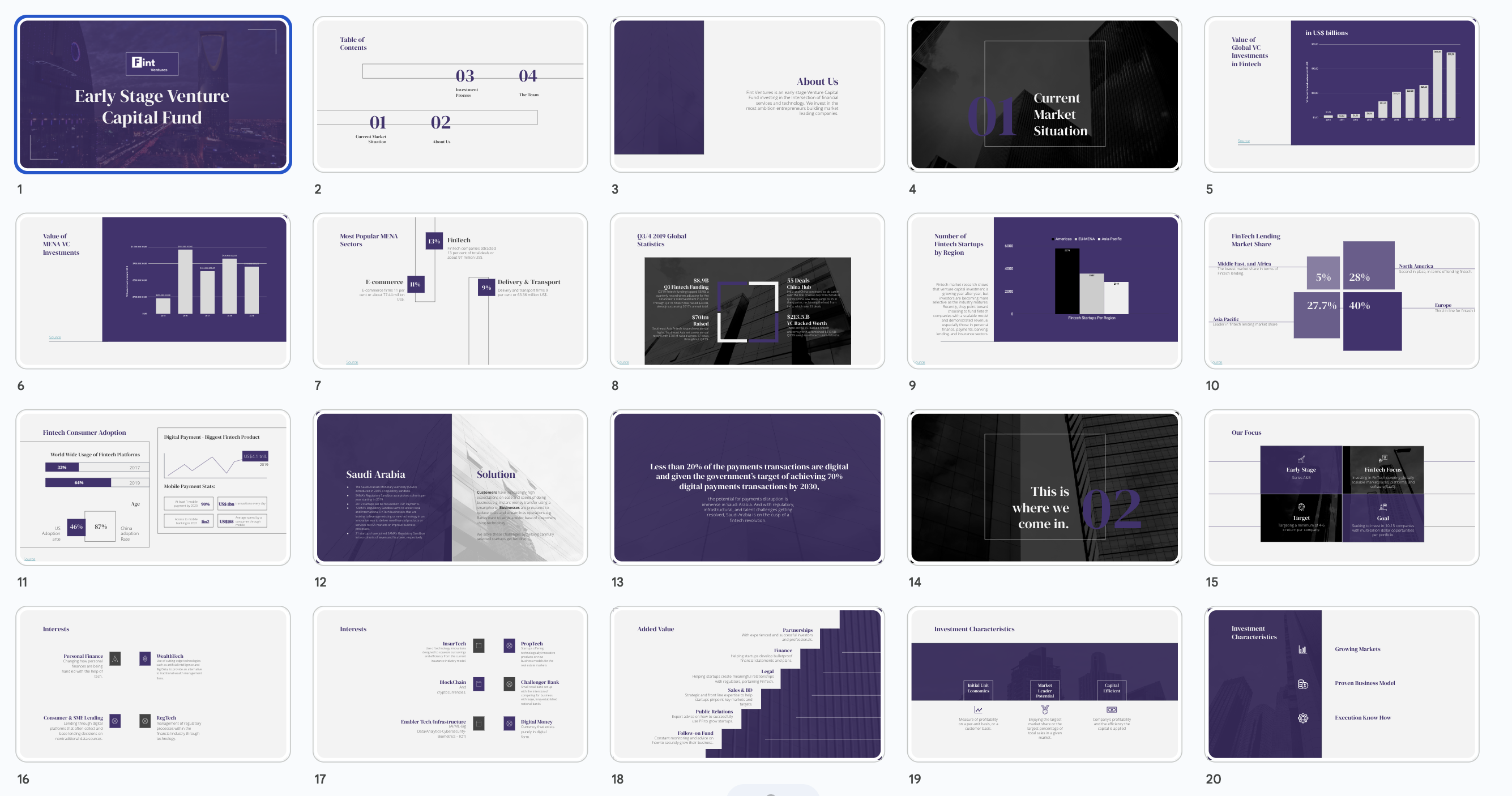
A Practical Build Sequence for Structuring an Investment Fund Pitch Deck
This section outlines a practical sequencing approach for assembling an investment fund pitch deck. It is not a prescriptive framework for how capital allocation decisions are made. Instead, it reflects a common build order that helps ensure required information is presented clearly, consistently, and in a form that can be reviewed efficiently.
In practice, this sequencing also determines how much information can realistically be included, which is why pitch deck length constraints matter when structuring a fund deck across different review contexts.
The steps below are best understood as assembly logic: a way to organize material so reviewers can evaluate the fund without needing to reconstruct assumptions, chase missing context, or infer intent.
Step 1: Define the Fund Mandate and Operating Objective
Before slides are designed, the fund’s mandate must be explicit. This is not about positioning—it is about clarity.
Execution focus:
- What type of fund this is (strategy, structure, lifecycle)
- What the fund is designed to do repeatedly
- Where the fund is intentionally constrained
From an execution standpoint, this step ensures that every subsequent slide can be interpreted against a stable reference point. Without a clearly defined mandate, later sections tend to over-explain or contradict each other.
Funds that need to support both quick screening and deeper reference often resolve this by maintaining short vs long fund deck formats derived from the same underlying structure.
Step 2: Establish Credibility Through Structure and Track Record
At build level, credibility is not asserted—it is demonstrated through organization and evidence placement.
Execution focus:
- Where prior experience is shown
- How attribution is clarified
- How past activity is separated from future intent
For first-time funds, this step is about decision context rather than outcomes. The goal is to make responsibility, judgment, and experience legible without overstating conclusions.
Step 3: Present the Investment Strategy as a Repeatable Process
This step translates strategy into operational logic, not a thesis statement.
Execution focus:
- How opportunities are identified
- How decisions are filtered
- How capital is deployed and exited
The emphasis here is on internal consistency. Reviewers should be able to trace how opportunities move from sourcing to realization without narrative gaps.
Step 4: Explain the Economic and Financial Logic
Financial slides exist to make assumptions visible and testable.
Execution focus:
- How returns are generated
- How costs and incentives interact
- How projections connect to strategy mechanics
This step is about coherence, not optimization. Clean logic is more useful at review stage than aggressive modeling.
Step 5: Show Governance, Alignment, and Execution Discipline
This step addresses how the fund operates once capital is committed.
Execution focus:
- Decision authority and oversight
- Reporting and control mechanisms
- How deviations are handled
From a deck-building perspective, this section reduces uncertainty about post-commitment behavior. It signals that the fund is designed to function under scrutiny, not just during fundraising.
How to Use This Sequence
This build sequence is not mandatory, universal, or exhaustive. It is a practical ordering tool that helps ensure your deck supports structured review rather than resisting it.
The sections that follow break this sequence down into specific slides, examples, and formatting considerations—so the deck can be assembled with intention and reviewed without friction.
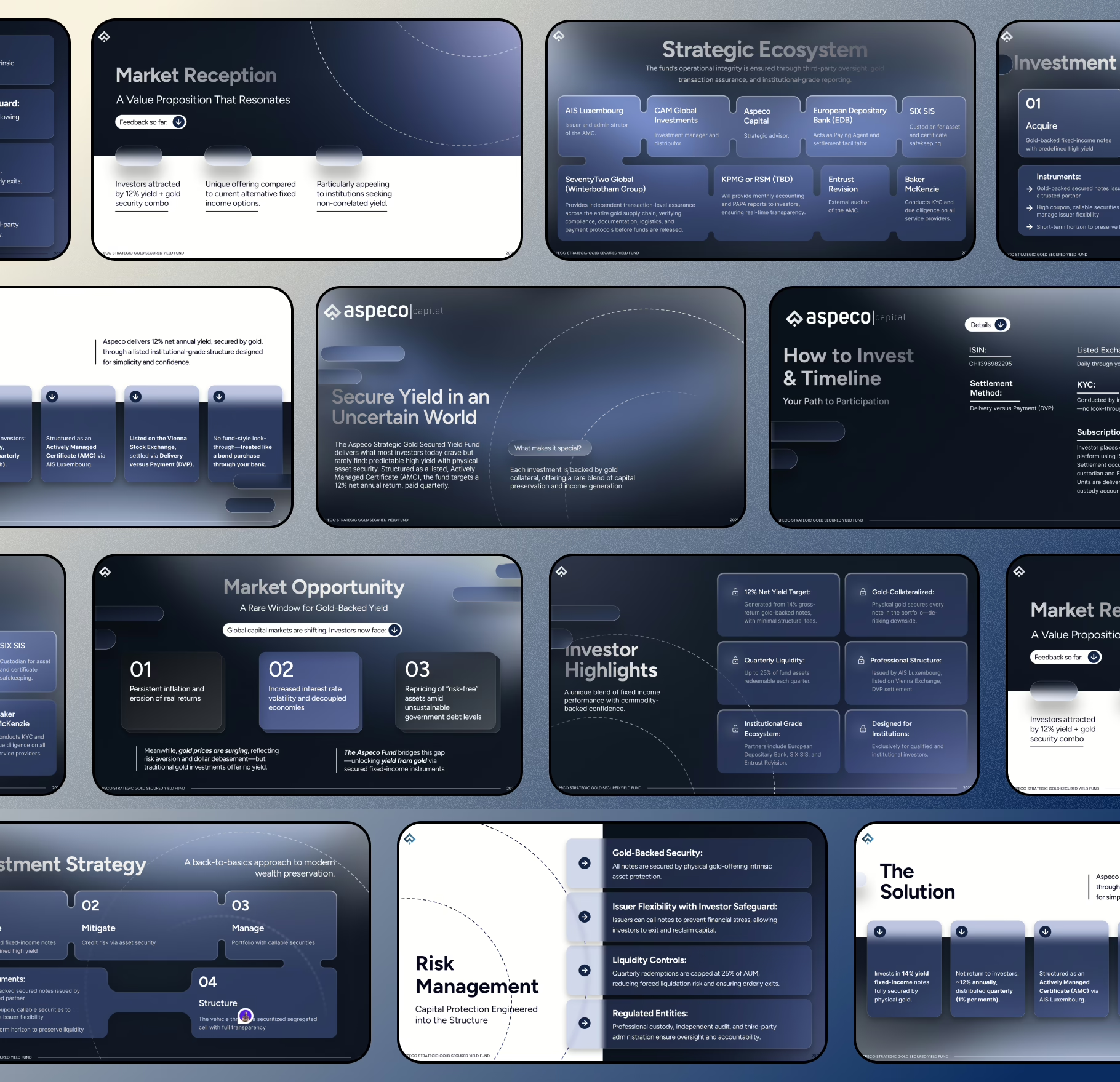
A Standard Slide Set Commonly Used in Investment Fund Pitch Decks
This section outlines a commonly used slide set for investment fund pitch decks. It is not a universal requirement, a guarantee of approval, or a definitive representation of how capital allocation decisions are made.
The purpose of this structure is practical: it reflects how information is typically organized so that a fund can be reviewed, compared, and discussed within formal evaluation processes. Individual funds may adapt, compress, or expand this structure depending on strategy, jurisdiction, or audience—but deviations should be intentional, not accidental.
What follows focuses on what each slide is responsible for conveying, from an execution standpoint.
Slide 1 — Fund Overview
Execution role: Establish context and orientation.
This slide anchors the deck by clearly stating what the fund is, what it does, and how it should be interpreted.
Typical components:
- Fund name and structure
- Strategy type and focus
- Target fund size and lifecycle
- Confidentiality status (where applicable)
The goal is to prevent early ambiguity. Reviewers should know immediately what kind of fund they are evaluating.
Slide 2 — Investment Thesis
Execution role: Define the core rationale behind the fund’s existence.
This slide summarizes why the fund operates in its chosen space and how it intends to create value—without relying on trend language or broad market claims.
Typical components:
- Core opportunity framing
- Value creation logic
- Constraints or exclusions
This is not a marketing statement. It is a reference point for interpreting later assumptions.
Slide 3 — Market Opportunity
Execution role: Provide context for scale and relevance.
Rather than maximizing market size, this slide clarifies:
- Which segments matter
- Why they are accessible
- How they relate to the fund’s mandate
The emphasis is on fit, not magnitude.
Slide 4 — Investment Strategy
Execution role: Translate thesis into action.
This slide explains how capital moves from intent to deployment.
Typical components:
- Sourcing approach
- Selection criteria
- Ownership posture
- Exit pathways
Clarity here reduces the need for speculative interpretation later in the review.
Slide 5 — Portfolio Construction
Execution role: Show how risk and exposure are managed at the portfolio level.
This slide focuses on structure rather than performance.
Typical components:
- Number of investments
- Check sizes
- Diversification logic
- Concentration limits
It helps reviewers understand how individual decisions aggregate into a portfolio.
Slide 6 — Track Record (Where Applicable)
Execution role: Provide evidence of prior decision-making.
This slide is about context, not promotion.
Typical components:
- Prior investments or roles
- Attribution clarity
- Outcomes, where relevant
For first-time funds, this slide often emphasizes decision responsibility rather than exits.
Slide 7 — Case Examples
Execution role: Illustrate strategy in practice.
Case examples are used to:
- Show how the strategy operates
- Demonstrate consistency of approach
- Clarify value creation mechanisms
They are most effective when they reinforce process, not just outcomes.
Slide 8 — Team and Decision Roles
Execution role: Make responsibility and authority legible.
This slide clarifies:
- Who makes decisions
- Who executes
- Who oversees
Clear role definition reduces ambiguity during governance review.
Slide 9 — Fund Economics and Alignment
Execution role: Explain how incentives interact.
This slide focuses on:
- Fee structure
- Carry mechanics
- Alignment considerations
The goal is transparency, not negotiation.
Slide 10 — Financial Projections and Return Logic
Execution role: Make assumptions explicit.
This slide shows:
- How returns are generated
- How scenarios are modeled
- How projections connect to strategy
Precision matters more than optimism.
Slide 11 — Governance and Reporting
Execution role: Show how the fund operates post-close.
Typical components:
- Reporting cadence
- Oversight mechanisms
- Risk escalation processes
This slide addresses operational continuity, not fundraising.
Slide 12 — Capital Raise and Next Steps
Execution role: Close the loop.
This slide outlines:
- Target raise
- Use of proceeds
- Timing and process
It provides procedural clarity without persuasion.
How This Slide Set Should Be Used
This structure is not a rulebook. It is a compatibility model—a way to ensure your deck can be reviewed without friction, misinterpretation, or unnecessary back-and-forth.
The sections that follow break down each slide in more detail, with formatting guidance, examples, and common execution errors.
Common Execution Breakdowns That Cause Fund Pitch Decks to Stall or Exit Review
This section does not describe how LPs make decisions or why capital is ultimately allocated or declined. Instead, it highlights recurring execution issues that commonly cause fund pitch decks to slow down, require clarification, or stop progressing within formal review processes.
In most cases, these outcomes are not driven by a single fatal flaw. They occur when a deck introduces unnecessary ambiguity, inconsistency, or friction that makes structured evaluation difficult or inefficient.
What follows focuses on execution-level breakdowns—not judgments.
1. Unclear Fund Mandate or Scope
When a fund’s mandate is not precisely defined, reviewers must infer intent. In structured review environments, inference increases risk.
Execution breakdowns include:
- Strategy descriptions that shift across slides
- Inconsistent use of terminology
- Blurred boundaries between what the fund will and will not do
Clear scope reduces the need for follow-up clarification.
2. Strategy Presented as Narrative Rather Than Process
Decks often describe what the fund believes without explaining how decisions are made.
Execution breakdowns include:
- High-level theses with no operational translation
- Case studies disconnected from decision logic
- Outcomes shown without context on repeatability
Process clarity supports evaluation far more than storytelling density.
3. Financial Logic That Is Difficult to Trace
Financial models are often technically correct but poorly integrated into the deck.
Execution breakdowns include:
- Projections that cannot be reconciled with strategy slides
- Assumptions that are implicit rather than explicit
- Scenarios that appear optimized rather than bounded
When logic cannot be followed cleanly, review slows.
4. Misaligned Incentives or Governance Ambiguity
Unclear roles and incentives introduce downstream uncertainty.
Execution breakdowns include:
- Decision authority not clearly defined
- Economics presented without governance context
- Oversight mechanisms described vaguely or late in the deck
These issues typically trigger additional diligence rather than immediate conclusions.
5. Overemphasis on Upside, Underrepresentation of Risk
Decks that attempt to remove all visible risk often create the opposite effect.
Execution breakdowns include:
- One-sided projections
- Absence of downside scenarios
- Risk language limited to disclaimers
Balanced framing helps reviewers understand how the fund operates under stress, not just success.
6. Structural Inconsistency Across Slides
Even strong content can break down if the deck lacks internal coherence.
Execution breakdowns include:
- Redundant slides with overlapping roles
- Conflicting metrics across sections
- Visual or structural noise that obscures priority information
Consistency supports efficient review and comparison.
7. Missing or Underdeveloped Operational Detail
Some decks assume operational mechanics are “understood” and omit them.
Execution breakdowns include:
- Vague descriptions of sourcing or execution
- Limited explanation of post-investment involvement
- Reporting and control mechanisms treated as afterthoughts
Operational gaps often pause progression until resolved.
Why These Issues Matter
In institutional review contexts, a deck does not need to be perfect—but it must be workable. The most common reason decks exit review is not disagreement with the idea, but difficulty in evaluating it responsibly with the information provided.
The sections that follow focus on how to structure slides and supporting material to minimize these breakdowns and keep evaluation moving forward.
How Fund Pitch Decks Are Typically Reviewed Within Institutional Processes
This section does not describe how LPs make investment decisions or how capital allocation outcomes are determined. Instead, it focuses on how fund pitch decks are commonly handled as review materials once they enter formal evaluation environments.
The emphasis here is not on judgment, persuasion, or approval criteria. It is on process flow—how information is accessed, referenced, and stress-tested across multiple stages of review. Understanding this flow helps fund managers structure decks so they can be reviewed efficiently, without introducing avoidable friction.
1. Initial Orientation and Classification
At early stages, a deck is typically used to establish basic orientation rather than to reach conclusions.
Execution context:
- What type of fund this is
- Where it fits within an existing mandate
- Whether the scope is understandable at a glance
At this stage, reviewers are not analyzing depth. They are determining whether the material can be routed appropriately for further review.
2. Structural Scanning Before Detail Review
Before individual slides are examined in depth, decks are often scanned for structure and completeness.
Execution context:
- Are all core components present?
- Is information logically sequenced?
- Can assumptions be located without searching?
This scan determines whether the deck is usable as a reference document, not whether the strategy is compelling.
At this stage, clarity depends less on content density and more on deck layout and information hierarchy, which determine whether reviewers can locate key material without friction.
Many early breakdowns at this stage stem from common pitch deck layout mistakes that obscure priority information rather than missing content altogether.
3. Section-by-Section Validation, Not Linear Reading
Fund pitch decks are rarely read top-to-bottom in a single pass.
Execution context:
- Sections are revisited out of order
- Slides are cross-checked against each other
- Specific pages are extracted for discussion or comparison
This makes internal consistency and slide independence critical. Each slide should stand on its own without contradicting adjacent material. When slides attempt to do too much at once, evaluation slows, which is often a signal that further simplification of complex slides is needed.
This is why decisions around text-heavy vs image-heavy slides matter at an execution level, especially when individual slides are reviewed in isolation.
4. Cross-Referencing Strategy, Economics, and Governance
As review progresses, attention often shifts to alignment across sections.
From an execution standpoint, this requires presenting financials clearly so that assumptions can be traced back to strategy without reinterpretation.
Execution context:
- Strategy slides are compared against financial assumptions
- Economics are reviewed alongside governance structures
- Track record is interpreted through decision responsibility
Breakdowns usually occur not within individual slides, but between them. Projections are most usable during review when they are explicitly connected to underlying mechanics, which is why many teams rely on a dedicated financial projections structure rather than standalone models.
5. Question Generation and Information Gaps
Formal review processes generate questions as a function of missing or unclear information, not disagreement. Many of these questions can be anticipated and reduced through better execution, particularly by planning for how follow-up questions are handled rather than reacting to them ad hoc.
Execution context:
- Gaps trigger follow-up requests
- Ambiguity slows progression
- Over-compressed slides create interpretation risk
Well-executed decks reduce the volume of clarification required. In practice, the same execution patterns recur across funds, making common pitch deck execution mistakes a useful diagnostic reference during deck preparation.
6. Use of the Deck as a Living Reference
In later stages, the deck often becomes a working document rather than a presentation. This is why effective teams focus on framing slides for reuse, ensuring individual pages can function as standalone reference material outside of live presentations.
Execution context:
- Slides are referenced in meetings
- Figures are quoted or re-used
- Structure is relied on for internal summaries
This is why clarity, restraint, and consistency matter more than rhetorical impact. Visual consistency and restraint also matter here, as visual storytelling techniques directly affect how reliably slides can be reused across internal review contexts.
Why This Matters for Execution
A fund pitch deck is not consumed as a single narrative moment. It is handled, revisited, compared, and stress-tested over time by multiple parties.
From an execution standpoint, the goal is not to control interpretation—but to make responsible interpretation possible without unnecessary friction.
The sections that follow focus on slide-level construction and formatting choices that support this type of review behavior.
Execution Note
This guide is intended to support the practical assembly of an investment fund pitch deck. It focuses on structure, sequencing, and presentation mechanics that help the material be reviewed efficiently within formal evaluation processes.
Decisions about capital allocation, mandate fit, and approval criteria are defined upstream. The purpose of this page is to translate those expectations into a usable, review-ready document—not to reinterpret or replace them.
